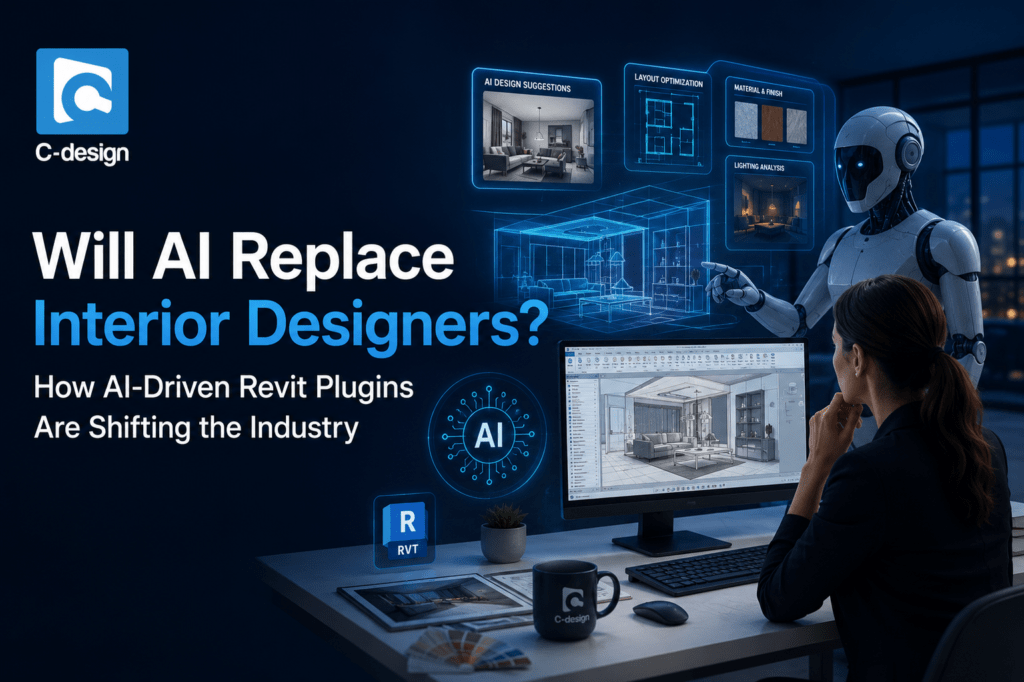
Will AI Replace Interior Designers? How AI-Driven Revit Plugins Are Shifting the Industry
Posted on : Jul 24, 2026
Will AI Replace Interior Designers? How AI-Driven Revit Plugins Are Shifting the Industry
Walk into any architecture or interior design studio today, and you’ll notice something different from just five years ago. Alongside sketchbooks, mood boards, and material samples, there’s now a screen running Revit with an AI plugin quietly generating layout options, calculating lighting loads, or rendering a photorealistic walkthrough in seconds. The question on everyone’s mind — from freelance designers to large design-build firms — is simple but loaded: will AI replace interior designers?
It’s a fair question. AI has already disrupted content writing, graphic design, and even architectural drafting. Now, AI-driven Revit plugins are automating tasks that once took interior designers hours or days — space planning, furniture layout optimization, material selection, and rendering. Naturally, this raises anxiety among professionals who’ve spent years mastering their craft.
Here’s the short answer: AI is not replacing interior designers — it’s replacing repetitive, time-consuming tasks within the design process. The designers who thrive in this new era will be the ones who learn to work alongside these tools rather than against them.
In this article, we’ll break down exactly how AI-driven Revit plugins are reshaping interior design workflows, what tasks are being automated, what remains irreplaceably human, why firms like Outsourcing CAD Works are becoming trusted partners in this shift, and how design professionals can adapt to stay competitive in an AI-augmented industry.
The Rise of AI in Interior Design: Why Now?
Interior design has always been a blend of art and technical precision. For decades, tools like AutoCAD and Revit modernized how designers document and visualize spaces, but the actual creative decision-making — furniture placement, spatial flow, color palettes, material harmony — remained a manual, experience-driven process.
That’s changing rapidly. Several factors are driving the current wave of AI adoption in interior design:
- Faster client turnaround expectations. Clients today want design concepts and 3D visualizations within days, not weeks.
- Rising labor costs and project complexity. Firms are under pressure to do more with leaner teams.
- Maturing generative AI models. Machine learning algorithms can now understand spatial constraints, building codes, and aesthetic preferences well enough to generate usable design options.
- BIM integration. Since most commercial and many residential interior projects already run on Building Information Modeling (BIM) platforms like Revit, it made sense for AI developers to build directly into that ecosystem rather than create standalone tools.
This convergence has given rise to a new category of software: AI-driven Revit plugins built specifically for interior design workflows, capable of automating floor plans, furniture layouts, lighting simulations, and material takeoffs.
What Are AI-Driven Revit Plugins, Exactly?
For those less familiar with the technical side, Revit is a leading Building Information Modeling software used by architects, interior designers, and MEP engineers to create detailed, data-rich 3D models of buildings and spaces. Traditionally, every wall, furniture piece, and finish had to be placed and adjusted manually.
AI-driven Revit plugins are add-on tools that integrate directly into this environment and use machine learning or rule-based algorithms to automate specific tasks. Some of the most impactful capabilities include:
1. Automated Space Planning
Instead of manually testing dozens of furniture arrangements, AI plugins can generate multiple space-planning options based on room dimensions, function, traffic flow, and building codes — all within minutes.
2. Furniture and Fixture Placement Optimization
AI algorithms analyze room geometry and suggest optimal furniture placement that maximizes usability, accessibility, and visual balance, factoring in ergonomic standards and clearance requirements automatically.
3. Lighting and Energy Simulation
Plugins can simulate natural and artificial lighting conditions throughout the day, helping designers make informed decisions about fixture placement and window treatments without needing separate lighting design software.
4. Material and Finish Recommendations
Some AI tools cross-reference design style, budget, and sustainability goals to recommend flooring, wall finishes, and textiles that align with the project’s vision.
5. Instant Rendering and Visualization
Perhaps the most visible benefit: AI-powered rendering engines can generate photorealistic interior visuals in a fraction of the time traditional rendering software requires, letting designers present concepts to clients almost instantly.
6. Quantity Takeoffs and Cost Estimation
By analyzing the BIM model, plugins can automatically generate material quantities and rough cost estimates — a task that traditionally required painstaking manual calculation.
Together, these capabilities are compressing project timelines that once took weeks into days, and in some cases, hours.
The Tasks AI Is Genuinely Good At Replacing
To understand the real impact on interior designers’ jobs, it helps to separate tasks into two buckets: those that are mechanical and repetitive, and those that require human judgment, empathy, and creative synthesis.
AI-driven Revit plugins excel at:
- Generating multiple layout iterations quickly
- Checking designs against building codes and accessibility standards
- Producing accurate material quantity takeoffs
- Running lighting and energy simulations
- Creating fast, photorealistic renders for client presentations
- Managing repetitive documentation and drafting updates
These are exactly the tasks that consumed enormous amounts of designers’ time without necessarily requiring their creative expertise. Automating them doesn’t eliminate the need for designers — it removes the drudgery so designers can focus on higher-value work.
What AI Still Can’t Replace in Interior Design
This is where the “AI will replace interior designers” narrative starts to fall apart. Despite how impressive these plugins are, several core aspects of interior design remain deeply human:
1. Understanding Client Emotion and Lifestyle
A homeowner doesn’t just want a “functional” living room — they want a space that reflects how their family actually lives, entertains, relaxes, and grows over time. AI can’t sit across the table and read between the lines of what a client says versus what they truly mean.
2. Creative Vision and Storytelling
Great interior design often tells a story — blending history, culture, personal identity, and emotion into a cohesive spatial narrative. AI can recombine existing patterns, but it doesn’t originate genuine creative concepts rooted in lived human experience.
3. Navigating Ambiguity and Trade-offs
Real projects involve budget constraints, structural limitations, client indecision, and shifting priorities. Skilled designers negotiate these trade-offs with judgment that algorithms simply don’t possess.
4. Building Trust and Managing Relationships
Interior design is a deeply relational profession. Clients are inviting someone into their homes, businesses, and financial decisions. Trust, communication, and reassurance during a stressful renovation process cannot be automated.
5. Ethical and Cultural Sensitivity
Designing for diverse cultural contexts, accessibility needs, or sensitive environments (like healthcare or elder care facilities) requires nuanced understanding that goes beyond pattern recognition.
In short: AI can generate options, but humans decide what’s right for a specific client, culture, and context.
How the Industry Is Actually Shifting
Rather than a wholesale replacement of interior designers, what we’re seeing is a shift in how design work gets done — and who gets to do it efficiently.
From Manual Execution to Strategic Oversight
Designers are increasingly becoming curators and strategists rather than manual drafters. They review AI-generated layout options, refine them based on client needs, and make the final creative calls — similar to how a photographer might use AI-assisted editing tools but still controls the final artistic vision.
Smaller Firms Can Compete With Larger Ones
AI-driven Revit plugins are a massive equalizer. A two-person interior design studio can now produce the same speed and polish of visualization and documentation that used to require a large in-house team. This democratization is reshaping competitive dynamics across the industry.
New Skill Requirements Are Emerging
Designers who understand how to prompt, guide, and refine AI outputs — essentially “directing” the AI rather than doing everything manually — are becoming more valuable. Familiarity with BIM workflows, AI plugin ecosystems, and data-driven design decision-making is quickly becoming a differentiator on resumes and portfolios.
Outsourcing and Remote Collaboration Are Accelerating
Because AI plugins standardize much of the technical heavy lifting within Revit, it’s now easier than ever for firms to outsource CAD drafting, BIM modeling, and rendering work to specialized studios — allowing in-house designers to focus purely on client-facing creative strategy.
Faster Iteration Means Better Client Experiences
Clients no longer have to wait weeks to see revised design concepts. AI-powered speed means more iteration cycles, which often leads to higher client satisfaction and fewer costly late-stage changes.
Real-World Applications: Where AI-Driven Revit Plugins Are Making an Impact
- Residential renovation firms use AI plugins to quickly generate multiple kitchen or bathroom layout options for clients comparing budgets and styles.
- Commercial interior design studios leverage AI for rapid space planning in office fit-outs, especially for hybrid workplace redesigns where flexible layouts are essential.
- Hospitality and retail designers use AI-driven rendering to produce marketing-ready visuals for investor presentations long before construction begins.
- Healthcare interior design teams use simulation tools to test lighting and wayfinding layouts that improve patient outcomes and staff efficiency.
Across all these use cases, the pattern is consistent: AI accelerates the technical and visualization side of the work, while human designers remain firmly in control of strategy, client relationships, and final creative decisions.
Why Outsourcing CAD Works Is a Reliable Partner for Interior Designers
As AI-driven Revit plugins become more central to interior design workflows, choosing the right technical partner matters more than ever. This is where Outsourcing CAD Works has built a reputation as a dependable extension of interior design teams navigating this transition.
Proven Expertise Across BIM and AI-Integrated Workflows
Outsourcing CAD Works brings hands-on experience with Revit, AI-driven plugins, and broader BIM ecosystems, meaning interior designers don’t have to spend months training staff or experimenting with unfamiliar software. The team already understands how to combine automated tools with the manual precision that complex projects demand.
Consistent Quality Control
Speed from AI tools only matters if the output is accurate. Outsourcing CAD Works applies structured quality checks to every deliverable — space planning layouts, renderings, documentation, and quantity takeoffs — so designers can trust what lands in their inbox without needing to re-verify every detail.
Scalable Support Without Long-Term Overhead
Rather than hiring and training an in-house technical team, interior design studios can scale up or down based on project volume. This flexibility is especially valuable for firms handling seasonal workloads or unexpected project surges.
Faster Turnaround Without Sacrificing Customization
Because the team is already fluent in AI-assisted Revit workflows, projects move quickly through space planning, rendering, and documentation stages — without resorting to generic, one-size-fits-all templates. Every deliverable is tailored to the specific project brief and client vision.
A True Extension of the Design Team
Outsourcing CAD Works positions itself not as a replacement for in-house creative talent, but as a technical partner that handles the heavy lifting of BIM modeling, drafting, and AI-assisted visualization — freeing interior designers to focus on client relationships and creative direction.
How Interior Designers Can Future-Proof Their Careers
If you’re an interior designer feeling uneasy about this shift, here’s the good news: adapting doesn’t require becoming a software engineer. It requires a mindset shift and a willingness to integrate new tools into your existing expertise.
- Learn the BIM ecosystem. Even a working knowledge of Revit and popular AI plugins makes you significantly more competitive and efficient.
- Focus on client relationship skills. As technical execution speeds up, the designers who differentiate themselves through communication, empathy, and trust-building will thrive.
- Position yourself as a creative director, not just an executor. Let AI handle iteration and drafting; spend your energy on vision, storytelling, and final decision-making.
- Collaborate with outsourced BIM and CAD specialists. Partnering with firms that already have AI-integrated Revit workflows can help you scale your practice without hiring a full in-house technical team.
- Stay current with emerging tools. The AI plugin landscape is evolving quickly; staying informed ensures you’re not caught off guard by industry shifts.
The Bottom Line: Augmentation, Not Replacement
So, will AI replace interior designers? Based on everything happening in the industry today, the answer is no — but it will absolutely replace the parts of the job that were never really about design in the first place: repetitive drafting, manual layout testing, and slow rendering cycles.
AI-driven Revit plugins are best understood as powerful assistants, not competitors. They free up designers to spend more time on what truly matters — understanding clients, crafting meaningful spaces, and delivering creative solutions that no algorithm can originate on its own. The designers and firms that embrace these tools early, and partner with reliable technical specialists like Outsourcing CAD Works, will be the ones setting the pace for the industry’s next chapter.
How Outsourcing CAD & BIM Services Empowers Interior Designers
To stay competitive in an AI-shifted market, successful interior design and architectural firms are adopting a hybrid operational model: keep core creative strategy, client relations, and concept design in-house, while leveraging specialized external experts for heavy drafting, BIM modeling, and technical CAD production.
At OutsourcingCADWorks.com, we bridge the gap between creative vision and technical BIM execution.
Why Partner with Outsourcing CAD Works?
By delegating technical Revit drafting, 3D BIM modeling, and CAD documentation to dedicated specialists, your firm can maximize the benefits of modern technology without the overhead cost of maintaining huge internal technical teams.
Key Services We Offer to Interior Designers & AEC Firms:
- Detailed Revit Interior BIM Modeling: Transforming preliminary interior concepts, hand sketches, or AI-generated ideas into accurate, data-rich Autodesk Revit models.
- 2D CAD Drafting & Construction Documentation: Producing floor plans, reflected ceiling plans (RCPs), interior elevations, millwork details, and section drawings that adhere strictly to international standards.
- Furniture, Fixtures & Equipment (FF&E) Scheduling: Creating detailed parametric Revit families and structured schedules for accurate procurement.
- Point Cloud to BIM Conversion: Converting 3D laser scan data of existing structures into clean, precise Revit interior models for renovation projects.
- Clash Detection & Coordination: Ensuring interior elements co-exist seamlessly with MEP, structural, and architectural components before construction begins.
The Benefits for Your Design Practice:
- Focus on Core Creativity: Spend your time meeting clients, sourcing materials, and refining creative concepts while our team handles the heavy Revit/CAD workload.
- Scalability on Demand: Scale your technical drawing capacity up or down depending on project demand without adding fixed payroll overhead.
- Flawless Technical Accuracy: Avoid costly job-site errors with meticulously drafted, fully coordinated construction documents.
- Faster Turnaround Times: Utilize round-the-clock production capabilities to deliver project submittals well ahead of deadlines.
Ready to Modernize Your Interior Design Workflow?
At Outsourcing CAD Works, we help interior designers, architects, and design-build firms integrate AI-driven Revit workflows into their projects — from BIM modeling and space planning to photorealistic rendering and construction documentation. Whether you’re looking to speed up project delivery, scale your practice, or simply explore how AI can fit into your design process, our team is ready to help.
Get in touch with us today to discuss your next project and discover how our Revit and BIM expertise can help you stay ahead in an AI-driven design industry.
Conclusion & Call to Action
So, will AI replace interior designers? The answer is clear: AI is not an adversary looking to eliminate human creativity; it is a catalyst propelling the industry into a faster, smarter, and more data-rich era.
AI-driven Revit plugins are taking care of repetitive calculations, automated tagging, and instant rendering, giving interior designers the freedom to focus on what matters most—crafting exceptional, human-centered spaces that inspire, comfort, and function seamlessly.
To stay competitive in today’s fast-moving market, design firms must combine human artistic intuition with cutting-edge technical efficiency. You don’t have to navigate this shift alone.
Ready to Scale Your Design Practice and Streamline Your BIM Workflows?
Partner with Outsourcing CAD Works today! Let our team of expert CAD drafters and BIM specialists handle your complex Revit modeling, construction documentation, 2D drafting, and 3D coordination.
- Save up to 60% on technical production costs
- Accelerate project delivery timelines
- Maintain 100% focus on client relationships and creative design
👉 Visit OutsourcingCADWorks.com now to request a free quote or schedule a consultation for your next project!
Frequently Asked Questions (FAQs)
1. Will AI completely replace interior designers in the future?
No. AI automates repetitive and technical tasks like space planning, rendering, and documentation, but it cannot replace the creative judgment, emotional intelligence, and client relationship skills that define professional interior design.
2. What are AI-driven Revit plugins used for in interior design?
These plugins automate tasks such as space planning, furniture layout optimization, lighting simulation, material recommendations, rendering, and quantity takeoffs directly within the Revit BIM environment.
3. Are AI-driven Revit plugins expensive to adopt for small design firms?
Costs vary widely depending on the plugin and subscription model, but many tools are designed to be scalable, making them accessible even to small studios and freelance designers looking to compete with larger firms.
4. Do I need to learn coding to use AI plugins in Revit?
No. Most AI-driven Revit plugins are built with user-friendly interfaces designed for designers and architects, not programmers. Basic familiarity with Revit is usually sufficient to get started.
5. How is AI changing the interior design outsourcing industry?
AI is streamlining BIM modeling, drafting, and rendering workflows, making it easier and faster for firms to outsource technical design tasks while keeping creative direction in-house.
6. Can AI design an entire interior space without human input?
AI can generate design options and layouts based on input parameters, but final decisions around aesthetics, client preferences, budget trade-offs, and cultural context still require human expertise and oversight.
7. Why is Outsourcing CAD Works considered a reliable partner for interior designers adopting AI tools?
Outsourcing CAD Works combines hands-on expertise in Revit and AI-driven BIM workflows with structured quality control and scalable support, allowing interior designers to adopt new technology confidently without sacrificing accuracy or customization.
Article Tags & Keywords
Focus Keywords: Will AI Replace Interior Designers, AI-driven Revit Plugins, AI in Interior Design, Autodesk Revit Interior Design, BIM Outsourcing Services, CAD Drafting Outsourcing, Generative Design AEC
Related Blogs
Art assets in different styles like 2D art for interactive applications, Games, and UI. We are having more than 15 years of experience