The Ethics of AI Aesthetics: Avoiding the Trap of “Algorithmic Sameness” in Modern Design
Posted on : Aug 10, 2026
THE ETHICS OF AI AESTHETICS Avoiding the Trap of “Algorithmic Sameness” in Modern Design
By Outsourcing CAD Works | www.outsourcingcadworks.com
Artificial intelligence is changing how we design buildings, products, interiors, and brands. AI tools can generate endless variations, suggest layouts, and even create photorealistic visuals in seconds. But as AI becomes more common, a new concern is emerging: the risk of “algorithmic sameness.”
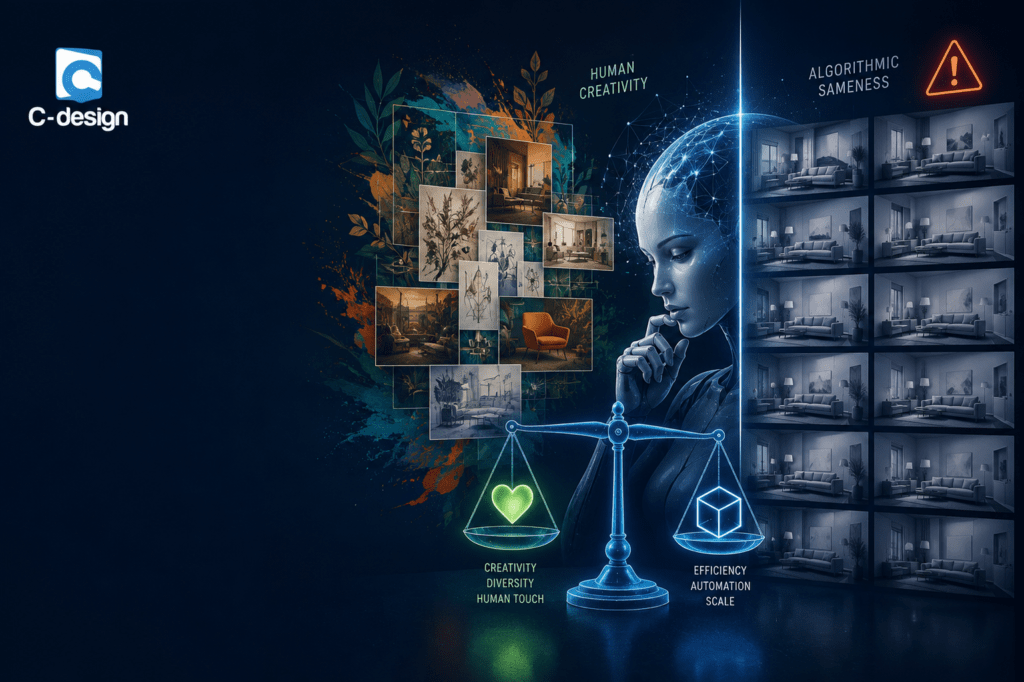
Algorithmic sameness happens when AI tools produce designs that feel similar, predictable, or overly optimized. When many designers use the same AI systems trained on the same datasets, outputs can start to look and feel alike. That is not just a creative problem. It is also an ethical one.
For design firms, studios, and architects, this raises important questions. How do we use AI responsibly? How do we keep human creativity at the center? And how can we avoid letting AI shape our aesthetics more than we intend?
This is where Outsourcing CAD Works can play a valuable role. By combining AI-assisted workflows with human-led CAD support, design teams can preserve originality, maintain ethical standards, and deliver more distinctive results.
What Is Algorithmic Sameness?
Algorithmic sameness describes a pattern where AI-generated designs start to converge toward similar styles, layouts, or visual languages. This happens because AI models learn from existing data. If that data is biased toward certain styles, trends, or popular solutions, the AI will tend to reproduce them.
In practice, this might mean:
- Interiors that share the same color palettes and furniture arrangements.
- Building facades that follow similar patterns.
- Product forms that look too familiar.
- Brand identities that feel generic.
On the surface, this may not seem harmful. But when AI shapes aesthetics too strongly, it can reduce diversity, suppress local culture, and make design feel less human.
Why It Is an Ethical Issue
The ethics of AI aesthetics go beyond aesthetics themselves. They touch on responsibility, originality, cultural sensitivity, and the role of the designer.
When AI systems influence design decisions, there are several ethical concerns:
- Loss of originality: If many designers rely on the same AI tools, innovation can stall.
- Cultural bias: AI trained on limited datasets may favor certain styles while ignoring others.
- Authorship confusion: It becomes unclear who is responsible for the final design.
- Client transparency: Clients may not know how much of the design was AI-generated.
- Professional accountability: Designers must ensure AI outputs meet safety, function, and quality standards.
These are not just technical issues. They shape how we practice design and how we serve clients and communities.
The Value of Human Judgment
AI is powerful, but it does not replace human judgment. Designers bring context, empathy, ethics, and creativity that AI cannot replicate. A human designer understands cultural nuance, client identity, and the emotional impact of space and form.
That is why human judgment must remain central. AI can suggest options, but designers should decide what is appropriate, meaningful, and responsible. This balance is essential to avoid algorithmic sameness.
When designers treat AI as a collaborator rather than a decision-maker, they preserve the integrity of their work. They can use AI to explore ideas faster while still steering the creative direction.
How Outsourcing CAD Works Supports Ethical AI Use
This is where Outsourcing CAD Works becomes especially useful. Ethical AI use requires structure, oversight, and human review. Outsourced CAD teams can help ensure that AI-generated ideas are translated into accurate, well-documented, and production-ready designs.
Outsourcing CAD support can help by:
- Preparing clean, accurate base drawings for AI workflows.
- Refining AI-generated concepts into buildable solutions.
- Ensuring documentation meets professional standards.
- Supporting revisions and quality checks.
- Reducing the risk of relying solely on automated outputs.
By combining AI with expert CAD support, design firms can maintain control over quality and originality while still benefiting from AI speed.
Practical Ways to Avoid Algorithmic Sameness
Designers and studios can take practical steps to keep their work distinctive and ethically sound.
- Diversify AI inputs: Use multiple tools and datasets to avoid over-reliance on one system.
- Edit and refine AI outputs: Treat AI results as starting points, not final answers.
- Maintain human oversight: Always review AI suggestions through a human lens.
- Prioritize local context: Consider culture, climate, and community in design decisions.
- Document AI usage: Be transparent with clients about how AI was used.
- Use CAD support to ground ideas: Turn AI concepts into precise, production-ready documentation.
These practices help designers stay creative while using AI responsibly.
The Role of Transparency and Accountability
Transparency is a key part of ethical AI use. Clients and stakeholders should understand how AI fits into the design process. This builds trust and ensures everyone knows where human judgment is applied.
Accountability is equally important. Designers must take responsibility for the final outcome, even if AI contributed to the process. That means reviewing outputs, checking for bias or errors, and ensuring the design meets all requirements.
When transparency and accountability are built into the workflow, AI becomes a tool for empowerment rather than a source of risk.
The Root Causes of Algorithmic Sameness
- Overlapping training datasets: Most generative AI design tools are trained on similar publicly available design libraries, so their “creative range” naturally converges.
- Default settings and templates: Many CAD and rendering tools ship with default parameters that most users never customize, producing near-identical outputs across projects.
- Speed-first workflows: Under tight deadlines, teams often accept the first AI-generated option instead of iterating toward something distinctive.
- Lack of domain-specific fine-tuning: Generic AI models aren’t tuned for a client’s brand, region, or engineering constraints, so they default to the statistical “middle.”
- Absence of skilled human review: Without experienced designers and engineers refining AI output, sameness goes unchallenged and unnoticed.
How to Avoid the Trap: Principles for Ethical AI-Assisted Design
The good news is that algorithmic sameness is not an inevitable side effect of using AI — it’s a management problem, and it’s solvable. Here’s how forward-thinking design and CAD teams are addressing it.
Treat AI as a Collaborator, Not a Decision-Maker
AI tools are extraordinary at generating options, running iterations, and handling repetitive drafting work. But the final creative and engineering decisions should always rest with a human expert who understands the client’s brand, the site context, the manufacturing process, and the end-user’s needs.
Curate and Localize Training Inputs
Where possible, design teams should fine-tune or guide AI tools using region-specific, brand-specific, or project-specific references rather than relying on generic global datasets. This keeps outputs relevant to local culture, codes, and client identity instead of defaulting to a generic global style.
Build in Deliberate Human Review Checkpoints
Every AI-assisted deliverable — a 3D model, a rendering, a structural layout — should pass through experienced human reviewers who check for originality, manufacturability, code compliance, and brand fit before it reaches the client.
Diversify Your Toolset and Talent Pool
Relying on a single AI platform, and a single, narrow in-house team, increases the risk of repetitive outputs. Partnering with a broader, more diverse pool of engineers and designers introduces varied perspectives that counteract algorithmic convergence.
Preserve the Human Signature
Great design has always carried a human signature — an engineer’s judgment call, a designer’s instinct for proportion, a drafter’s understanding of how a part will actually be assembled. Ethical AI adoption protects space for that signature instead of erasing it.
How Outsourcing CAD Works Helps You Design Ethically — Without Sacrificing Speed
At Outsourcing CAD Works, we believe AI should accelerate human creativity, not replace it. Our approach to CAD design, drafting, BIM modeling, 3D rendering, and engineering documentation is built around a simple philosophy: let automation handle the repetitive heavy lifting, and let experienced human engineers and designers protect the originality, accuracy, and intent of every project.
Here’s how that philosophy translates into real advantages for our clients:
1. Human-Led Review on Every AI-Assisted Deliverable
Every CAD drawing, 3D model, or rendering that passes through our studio is reviewed by qualified engineers and designers before delivery. We use AI and automation to speed up drafting, clash detection, and iteration — but the creative and technical judgment behind every final file is unmistakably human.
2. A Global, Diverse Team of Design Specialists
Outsourcing CAD Works draws on a diverse bench of architectural drafters, mechanical designers, structural engineers, and BIM specialists. This diversity of background and experience is a natural antidote to algorithmic sameness: your project benefits from varied design instincts, not a single automated default.
3. Custom, Project-Specific Design Standards
Instead of pushing every client toward a generic, one-size-fits-all output, we tailor our CAD standards, templates, and design language to each client’s brand, region, building codes, and industry requirements — ensuring your projects stay distinctive rather than interchangeable.
4. Faster Turnarounds Without Cutting Ethical Corners
Outsourcing your CAD, drafting, and modeling work to our team means you get the speed and cost efficiency of automation-assisted workflows, combined with the accountability of a dedicated human team that stands behind every deliverable, every tolerance, and every design decision.
5. Strict Accountability and Quality Control
We maintain clear, documented QA checkpoints across every project stage — concept, modeling, detailing, and final review — so there is always a responsible, qualified professional accountable for the design, not just an algorithm.
6. Cost-Effective Access to Senior Design Talent
By outsourcing to Outsourcing CAD Works, architecture firms, engineering companies, and manufacturers get access to senior-level CAD, BIM, and 3D modeling expertise at a fraction of the cost of building an in-house team — without sacrificing the originality and rigor that ethical design demands.
Why This Matters for Design Firms
For design firms, avoiding algorithmic sameness is not only about ethics. It is also about business value. Distinctive, original work attracts better clients, commands higher fees, and builds stronger reputations.
If a firm’s work starts to look like everyone else’s, it loses competitive advantage. That is why investing in human creativity, ethical AI use, and quality CAD support is so important.
Firms that balance AI efficiency with human originality will stand out in a crowded market. They will be seen as thoughtful, innovative, and trustworthy.
How Outsourcing CAD Works Adds Value
Outsourcing CAD Works helps design teams maintain quality and control while using AI tools. Whether the project is architectural, interior, product, or brand-related, outsourced CAD support ensures that designs are accurate, consistent, and ready for execution.
This support is especially valuable when AI is involved. It allows designers to experiment with AI-generated ideas while keeping the technical side of the work in expert hands. That balance makes it easier to avoid the trap of algorithmic sameness.
Real-World Benefits for Designers
When designers use AI ethically and combine it with strong CAD workflows, they gain several benefits:
- Faster concept development.
- More time for creative thinking.
- Better control over quality.
- Stronger client communication.
- Reduced risk of generic outputs.
- More distinctive design identity.
These advantages help firms deliver better work while staying true to their values.
The Future of Ethical AI in Design
The future of design will likely involve more AI, not less. That is why establishing ethical practices now is so important. As tools evolve, designers must remain intentional about how they use them.
Ethical AI use does not mean avoiding AI. It means using AI with awareness, responsibility, and human oversight. It means treating AI as a partner in the creative process rather than a replacement for it.
For firms that want to grow without losing their identity, this approach is essential.
Why Outsourcing CAD Works Is a Strong Partner
Outsourcing CAD Works supports design teams with accurate, reliable CAD production so they can focus on creative direction and ethical decision-making. Whether the need is for drafting, 3D modeling, documentation, or revision support, outsourcing gives teams the flexibility to work smarter.
That matters in a market where clients expect speed, originality, and quality. By reducing the load on internal staff, firms can respond faster, maintain higher standards, and deliver more distinctive results.
The Future: AI as an Amplifier of Human Creativity
The ethical path forward isn’t to reject AI in design and engineering — that ship has sailed, and the productivity gains are too significant to ignore. The real challenge is building workflows, teams, and quality-control systems that use AI to amplify human creativity rather than replace it. Firms that get this balance right will produce work that is both fast to deliver and genuinely distinctive; firms that don’t will blend into an ocean of interchangeable, algorithm-average design.
At Outsourcing CAD Works, this balance is not an afterthought — it’s the core of how we operate. Whether you need architectural CAD drafting, mechanical design, BIM modeling, 3D rendering, or full-scale engineering documentation, our team combines the efficiency of modern tools with the accountability and originality of experienced human professionals.
SEO Keywords
AI ethics in design, algorithmic sameness, AI aesthetics, ethical AI use, outsourcing CAD works, CAD outsourcing, design originality, AI in architecture, AI in interior design, design documentation, AI-generated design, human-centered design, responsible AI.
FAQs
1. What does “algorithmic sameness” mean in AI-driven design?
It refers to the growing visual and structural similarity among designs created with AI tools, caused by generative models being trained on overlapping datasets and defaulting to statistically “safe,” popular patterns rather than original ones.
2. Is using AI in CAD design and architecture unethical?
No — AI itself is a neutral tool. The ethical concern arises when AI outputs are used without human review, local context, or accountability, leading to homogenized, potentially unsafe, or culturally disconnected designs.
3. How can I tell if my design team is over-relying on AI?
Warning signs include accepting the first AI-generated option without iteration, using generic templates across all clients, skipping human QA on AI-assisted drawings, and producing designs that feel interchangeable with competitors’ work.
4. Does outsourcing CAD work make algorithmic sameness worse?
Not when done correctly. Outsourcing to a partner like Outsourcing CAD Works actually helps combat sameness by adding diverse, experienced human designers and structured review processes on top of any AI-assisted tools used in the workflow.
5. What industries are most affected by AI aesthetic homogenization?
Architecture, interior design, product design, and industrial/mechanical design are currently the most affected, since generative AI tools are widely used for concept generation, rendering, and rapid prototyping in these fields.
6. How does Outsourcing CAD Works ensure design originality?
Every AI-assisted deliverable goes through human-led review by qualified engineers and designers, uses project-specific standards instead of generic templates, and draws on a diverse global team to introduce varied design perspectives.
7. Can AI and human designers really work together effectively?
Yes. The most successful modern design workflows use AI for speed — drafting, iteration, clash detection — while human designers and engineers retain control over creative direction, cultural context, and final technical accuracy.
Ready to Design Smarter — Without Losing Your Originality?
At Outsourcing CAD Works, we help architecture firms, engineering companies, and manufacturers get the speed and cost savings of AI-assisted CAD workflows, backed by the judgment, accountability, and originality of a skilled human team. If you’re ready to break free from algorithmic sameness and deliver design work that truly stands out, let’s talk.
👉 Visit us at www.outsourcingcadworks.com to explore our CAD drafting, BIM modeling, 3D rendering, and engineering design services, or reach out today for a free project consultation.
Call to Action
If you want to use AI responsibly while keeping your designs original and high-quality, now is the time to build a smarter workflow. Outsourcing CAD Works helps design teams combine AI efficiency with expert CAD support so they can focus on creativity and ethical decision-making.
Whether you need drafting, 3D modeling, or documentation support, our team is ready to help. Visit www.outsourcingcadworks.com to learn more and see how we can support your design projects.
Tags
AI Ethics, Algorithmic Sameness, AI Aesthetics, Ethical AI Use, CAD Outsourcing, Outsourcing CAD Works, Design Originality, AI in Architecture, AI in Interior Design, Design Documentation, AI-Generated Design, Human-Centered Design, Responsible AI
Related Blogs
Art assets in different styles like 2D art for interactive applications, Games, and UI. We are having more than 15 years of experience